
About
About Us
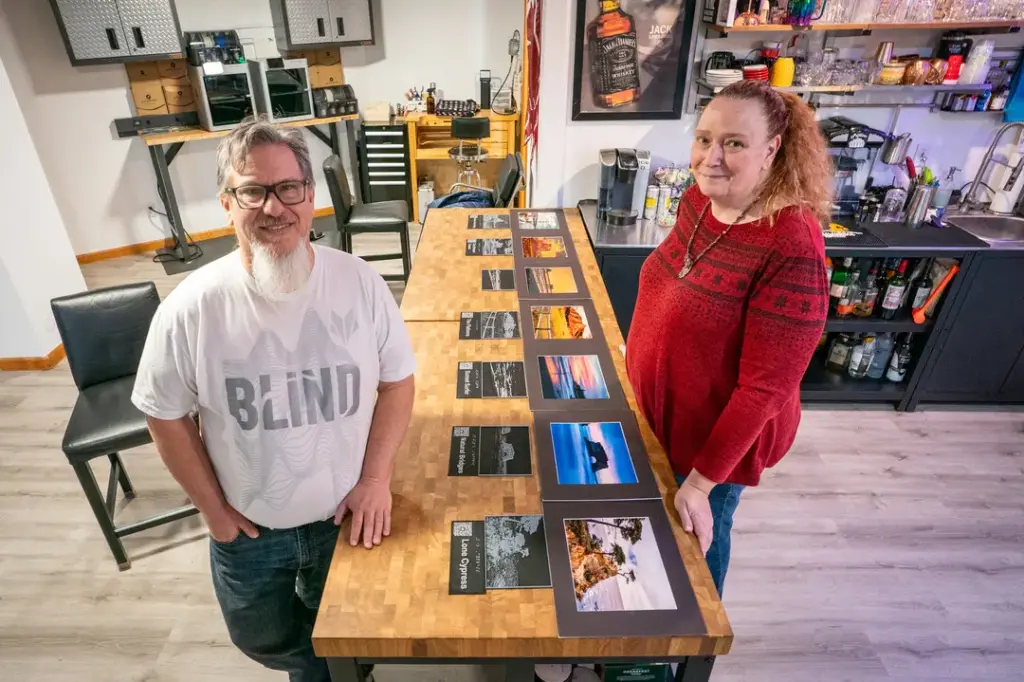
Tactile Photos is a collaborative art project by Ted and Carrie Tahquechi. We combine photography, tactile relief, and audio to create exhibitions where visitors are invited to explore photographs through more than sight.
Our work grew from a question we had been working through for years: how could a photograph offer Ted, a blind photographer, a meaningful experience through touch? Finding an answer took experimentation, a range of materials, and plenty of versions that taught us what to try next.
How the project began
For more than a decade, we explored ways to translate visual images into something Ted could feel. We tried applying glue to create raised details, building compositions from different materials, and working with resin. Each approach helped us understand more about the challenge of representing a photograph through touch.
Carrie’s experience in photography, jewelry, and physical art contributed to those experiments. Ted’s experience as a photographer programmer and a blind person helped us evaluate whether the results communicated the composition. We both wanted the tactile work to offer enough information for someone to explore an image and make their own discoveries.
Those experiments eventually led us to develop a process for translating brightness information and selected textures into a 3D-printable relief. In 2024, we introduced Tactile Photos at the National Federation of the Blind’s national convention in Florida, where visitors could explore the work and tell us about their experiences.
A shared artistic practice
We both contribute to the photography, artistic decisions, technical development, and accessibility of Tactile Photos. Creating each work involves considering how the photograph, tactile interpretation, and audio will function together.
Ted holds degrees in fine art photography, studio art photography, and communications. His work as a photographer, educator, and accessibility advocate informs the project, and he leads most of our public presentations.
Carrie brings her background in photography, jewelry, and tactile art to the collection. Her experience working with materials, texture, and physical form helped shape the early experiments and continues to inform the finished work.
Our collaboration carries through the entire process, from choosing photographs to preparing an exhibition and talking with the people who visit it.
What visitors experience
Each work has three components: an original photograph, a two-color tactile relief, and an accessibility plate with printed text, braille, and a tactile QR code. Visitors can use their phones to access an audio description and a guided tactile walkthrough.
The description introduces the photograph’s composition, light, setting, and key features. The walkthrough helps visitors orient themselves and locate those features in the relief. We are also adding place-based sound throughout the collection to provide another way to experience the settings in our photographs.
The tactile relief interprets the image through raised surfaces and selected textures. Its compact size allows visitors to explore the composition with their hands, while the two contrasting colors support visual exploration.
Learning from the people who visit
Exhibitions give us opportunities to hear what people discover in the work. A visitor may spend time tracing an architectural detail, ask about the relationship between brightness and height, or recognize a landscape they have visited. These conversations help us understand what communicates clearly and where someone needs more orientation or explanation. Supervised demonstrations are especially valuable because we can answer questions as people explore and hear their responses directly.
We welcome blind, low-vision, and sighted visitors. People arrive with different experiences of photography, touch, and the places represented in the collection. We want to give them time and useful information to form their own understanding of the work.
Sharing the collection
Our photographs span beaches, mountains, desert formations, architecture, and other subjects. The collection includes work from Rocky Mountain National Park, where Ted served as an artist in residence in 2026.
Since our 2024 debut, we have shared Tactile Photos through exhibitions, community events, and ongoing installations. We work with galleries, museums, disability organizations, and other community spaces to bring the collection to public audiences.
Exhibitions can be accompanied by demonstrations and presentations about photography, the tactile process, and practical approaches to accessibility in visual art.
Accessibility as part of the artwork
We want access to be considered while an exhibition is being planned. For our work, that means thinking about the photograph, touch, description, orientation, and how someone will approach and use the display.
Tactile Photos is one approach to making photography accessible. Through exhibiting the collection and sharing what we have learned, we also encourage artists and hosts to consider the ways people can participate in their own work.